On this page
Summary
I've found a few AEM sites exposing internal content through JSON responses. In one case, adding a trailing / to a blocked request let me browse an intranet and download files marked Confidential. The same misconfiguration turned up on other sites in that region, allowing me to farm more than 14 reports using the exact same methods and bypasses.
AEM
Adobe Experience Manager is a content management system. It uses Apache Sling to turn a URL into a request for a content resource, often stored in a Java Content Repository (JCR).
A Sling URL has a few parts. For an existing /content/example resource, it can look like this:
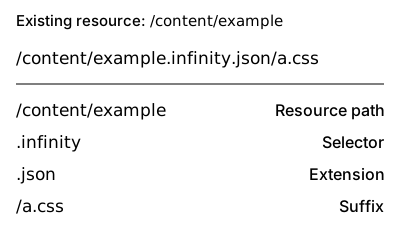
The .infinity part is a selector, .json is the extension, and /a.css is the suffix. That last bit matters when looking at filter bypasses. Sling's documentation explains the rules, including how the resource structure affects this split.
The finding
The company had separate sites for different regions, and one of them used AEM. I started with a wordlist of common AEM paths and found that /content/.json returned metadata for the content node.
I tried /content/.children.json to see what was underneath it, but got a 403. Adding a slash to make it /content/.children.json/ worked. The response listed child nodes, which gave me more paths to follow.
One of those was /content/intranet. Visiting /content/intranet/index directly gave me another 403, so I tried requesting it through a different selector:
/content/intranet.pages.json/
This returned its contents. I continued through the child paths, including /content/intranet/information.pages.json, and found HTML from the intranet in a text field.
There were also file URLs in the responses. Following those let me download documents marked Confidential. I included the readable intranet content and documents in the report, which was assessed as High severity.
Cause
The JSON responses make more sense once you look at Sling's DefaultGetServlet. It can render a resource as JSON if no more specific servlet handles the request. .tidy formats the output, while a number or .infinity controls how far it follows child resources, within configured limits. The servlet documentation covers those options.
I also checked /bin/querybuilder.json. It can search repository content and return properties using parameters such as path and p.hits=full. Adobe's QueryBuilder documentation has examples. For this these targets, it did not return anything.
Both still depend on repository permissions. A public page returned as JSON can be perfectly intentional.
Filters
Dispatcher filters requests before they reach AEM. A loose URL rule can miss the difference between an extension and a suffix. For example, these are worth comparing:
/content/example.infinity.json
/content/example.infinity.json/a.css
A rule allowing anything ending in .css might accept the second request, while Sling still sees a JSON extension.
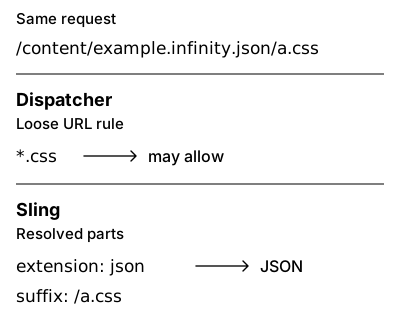
That depends on the site's configuration. In the finding above, a trailing slash was enough. I couldn't tell which exact filter rule caused it from the responses alone. Adobe supports filtering the path, selectors, extension and suffix separately.
Fixes
Protect the content with repository permissions, so anonymous users cannot read it even if a request passes Dispatcher.
For Dispatcher, allow only the requests the site needs. Check alternate selectors, suffixes and trailing slashes when testing the rules. Clear affected caches after changing filters, and check other sites using the same setup.
This issue has many bypasses, such as .xml, .json/a.xml, adding more / characters.