On this page
Summary
I found an IDOR in a profile update that let me overwrite another account's details. However, this site used UUIDs, and normally IDORs involving unpredictable UUIDs is not an issue.
However, I noticed their IDs were almost identical even though I had created them a short time apart. I looked into how those IDs were generated and found that they were based on UUIDv1 or RFC4122. The algorithm used to generate these is deterministic and are not random!
Finding IDOR
Testing for IDOR is pretty straightforward: create two accounts, see if updates on one account affects another by replacing the account identifier.
I created two accounts within a few minutes of each other. Each had a ContactId, which I could find in the browser's cookies. These were their IDs:
Account A: 90827c44-fcdb-f111-84e8-7ced8de54b88
Account B: ef07ce08-fcdb-f111-84e8-7ced8de54b88
Only the first group changed, with both ending in fcdb-f111-84e8-7ced8de54b88. I thought it was odd that so much of a seemingly random ID was the same, so I started looking into how they were made.
UUIDv1
These turned out to be UUIDv1 values, which are time-based. A UUIDv1 contains a timestamp, a clock sequence, and a node value. The timestamp is split across the first three fields, while the clock sequence helps avoid duplicate IDs. The RFC describes the fields here.
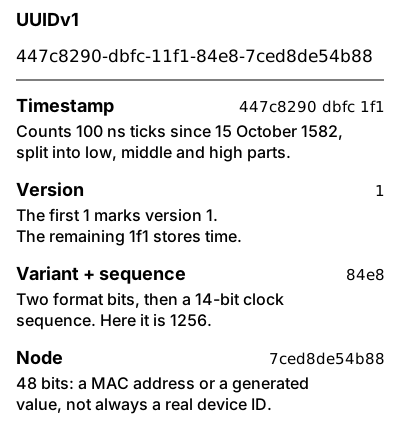
My samples shared the same clock sequence and node. The node can be a MAC address or a generated value, so seeing it repeat seemed to indicate this was a MAC address.
The RFC allows us to build a script to decode the UUIDs easily.
Decoding the UUIDs
This script here decodes the UUIDs to find out the exact time an account was created.
from datetime import datetime, timedelta, timezone
from uuid import RFC_4122, UUID

EPOCH = datetime(1582, 10, 15, tzinfo=timezone.utc)
SGT = timezone(timedelta(hours=8))
IDS = {
    "A": "90827c44-fcdb-f111-84e8-7ced8de54b88",
    "B": "ef07ce08-fcdb-f111-84e8-7ced8de54b88",
}


def decode(value):
    uid = UUID(bytes_le=bytes.fromhex(value.replace("-", "")))
    if uid.variant != RFC_4122 or uid.version != 1:
        raise ValueError("Expected UUIDv1 in this GUID byte order")

    microseconds, extra_digit = divmod(uid.time, 10)
    created = (EPOCH + timedelta(microseconds=microseconds)).astimezone(SGT)
    timestamp = f"{created:%Y-%m-%d %H:%M:%S}.{created.microsecond:06d}{extra_digit}"
    return uid, timestamp


decoded = {}
for label, value in IDS.items():
    uid, timestamp = decode(value)
    decoded[label] = uid
    print(f"{label}  {value}")
    print(f"    Time: {timestamp} SGT")
    print(f"    Clock seq: {uid.clock_seq}  Node: {uid.node:012x}")
    print()

gap_ticks = abs(decoded["A"].time - decoded["B"].time)
seconds, fraction = divmod(gap_ticks, 10_000_000)
print(f"Gap: {seconds}.{fraction:07d} s")
Running it gives the following times in Singapore time, UTC+8:
A  90827c44-fcdb-f111-84e8-7ced8de54b88
    Time: 2026-11-09 13:13:15.2448144 SGT
    Clock seq: 1256  Node: 7ced8de54b88

B  ef07ce08-fcdb-f111-84e8-7ced8de54b88
    Time: 2026-11-09 13:11:35.1157743 SGT
    Clock seq: 1256  Node: 7ced8de54b88

Gap: 100.1290401 s
So these UUIDs were not random at all, and were basically integers. This means the IDOR was a valid issue since an attacker can easily calculate more UUIDs to change details of other accounts.